
Why Spanish youth are voting for extreme right party “VOX”
Ginebra Rocha

“For Spain” “Let’s make Spain great again” are just some of the slogans used by Spanish far-right party VOX.
VOX derives its name from Latin and means “voice”. It aims to give voice to Spanish citizens who are tired of how the Spanish government has managed the upcoming economic and governmental crisis in the country in recent years.
The far-right party was founded on December 17, 2013 and its current president and leader of the movement is Santiago Abascal.
Vox emerged as a political party when several members of the main right-wing party in Spain PP “popular party” decided to distance themselves and founded VOX after differences within the popular party due to the management of Mariano Rajoy, former Spanish president during the Spanish economic crisis.
“I will no longer vote or support the popular party until I find a political party that deserves to be voted.” claimed a visibly angry militant.
A section of the Popular Party militancy approached the headquarters to demand Rajoy’s resignation. They claimed to feel betrayed.
“There were people who were very angry with Rajoy, a sector of the traditional Spain was very angry” said Carlos E. Cue a journalist for El Pais.
VOX emerged to represent those right-wing voters tired of the efforts of the popular party to lead Spain and its very many corruption schemes.
Although at the beginning of its political campaign the party had very little support and did not win any congress seats until 2018, the last elections on November 10th made VOX become a third political power, with more than fifty seats in the congress.
The rise of vox voters since 2018 has several underlying reasons: During the first two decades of the 21st century, while far-right parties grew more and more in Europe, Spain had always been an exception. This was fundamentally attributed to the fact that there was still a remaining memory of the extreme right-wing lead by Franco’s dictatorship that continued to persist in Spanish citizens.
But between December 2018 and April 2019, there was a turn of events: Spain equaled the rest of European countries with the irruption of the far-right party Vox, first in the Andalusian Parliament. with 12 deputies, and in the Congress of Deputies, later, obtaining for the first time since its foundation in 2013, 24 seats and that again doubled in the general elections of Spain in November 2019 when it obtained 52 deputies.
The rise of Vox as a political party coincided with the independence crisis in Catalonia and with the decision by the leading party PSOE (Spanish Socialist Workers Party) to carry out the exhumation of dictator Franco from the Valley of the Fallen.
The independence process in Catalonia has make its population have to choose a side. Those who are in favor of its independence and those who want a legal referendum where they can decide the future of Catalonia and on the other side, we also can find people who share the believe that “Spain is one and not fifty-one” and that “Spain is one, big and free country”.
This polarization has created a number of wounds that have caused even families to break up. Vox offers a quick and easy solution that has penetrated in the best possible way in that part of the population that is dissatisfied with independence and all that it entails, such as the many general strikes called in recent months and years, the barricades caused by disagreement with the ruling of the “process” or the right to self-determination that many people demand.
I talk to Anna Lopez, a law student who went to a Vox meeting the past 31 of October in Barcelona.
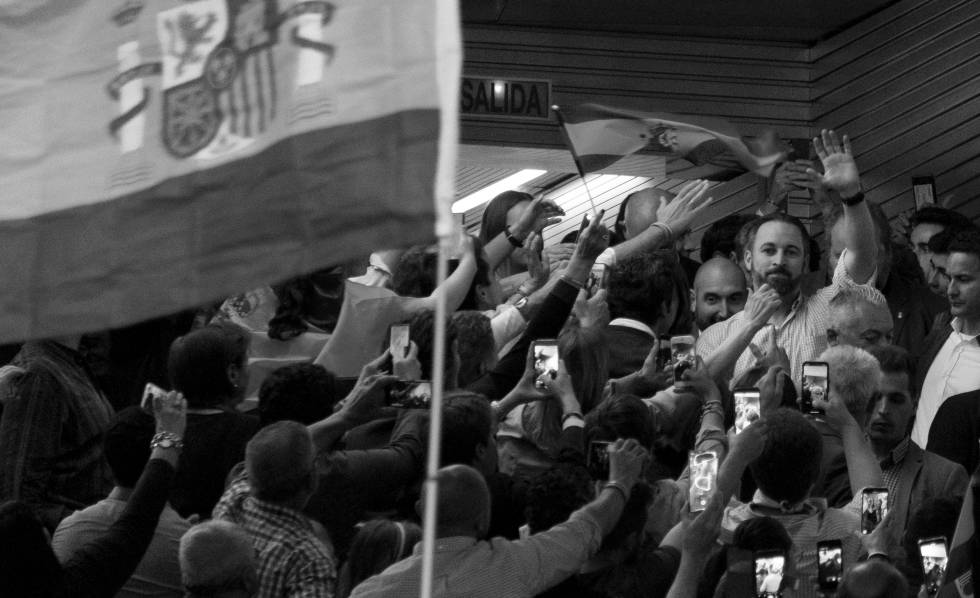
“I had the opportunity to see Santiago Abascal, its leader, and be able to hear his words live, it is not necessary to say that there was a lot of demagoguery and populism in his words, but it is also necessary to emphasize the atmosphere, starting from the base that the Farga (where the meeting was held) is a great pavilion, there were two rows of chairs occupying the whole pavilion, from the stage to the end of the room, practically all the chairs were full, maybe there was about 3,000 people. You could hardly see the stage with so many Spanish and Vox flags and if you looked closely, you could find some sign of apology to fascism (used during Franco’s dictatorship). Some televisions and radios were also restricted, such as TV3, the main Catalan TV media.”
Abascal clearly uses a populist message to get through its audience. “People were shouting louder than a Concert of Justin Bieber, but his message was so clear and precise, and it gave its people the solutions they where longing. He is without any doubt extremely charismatic and you could hear people singing along “Puigdemont should be in prison” or “Long Live to Spain and its Military”. Then Abascal went on to say immigrants where the ones who were stealing and burning our streets when they were not raping…” This was quite shocking for me, as usually when you see him in TV, he only talks about illegal immigrants entering our country without control, but this time, as he felt comfortable enough to be surrounded by all his supporters, he was talking about all immigrants including legal and non-legal. I felt like he felt the freedom to say that because everyone there had already made up their mind about giving them their vote, while on TV they have to go for a “softer” kind of speech as they want to get new votes too”.
Since after the transition (a stage known in Spanish history after the death of Franco when the constitution was made, and it restored democracy) there was a clear bipartisanism in Spain between the two parties that have always led: PP (Popular Party) and PSOE (Spanish Socialist Workers Party). It was not until 2016 when other parties began to enter politics, thus becoming a multiparty system where both Left and Right tend to share government with other micro-parties such as “Ciudadanos”, Podemos or in this case Vox.
When talking about the VOX voter profile in Spain, it is often mistakenly believed that the votes received by the far-right party come across from older people in the deep roots of the center of Spain. It’s believed that their parents were of Francoist ideology and that fought in Franco’s side at the Spanish civil war.
But surprisingly VOX has a large audience and connects a lot with young people, even in Catalonia.
They have a platform called VOX youth, in which one can become a member and attend the meetings they do, and they also have a lot of support on social networks such as Instagram and twitter.
In the upper side of Barcelona, a far-right group that make themselves be called “The ones from Artos” usually gather in the same square to show their support for VOX.
I have the opportunity to speak with some of its members after they themselves attended a rally against independence on the 24th of February.
Marc Blanquez is twenty years old, and he is a business administration student in Barcelona who was originally born in the city of Granada.
Both his grandfather and his brothers were Franco supporters. Although he says that does not influence his vote.
“I vote for Vox because it is the only party that does not seek to continue increasing the public debt in an excessive way and they try to direct public spending in an efficient way to help small businesses grow, contributing to a better country’s productivity.”
He declared himself “against” maintaining a state that wants to live at the expense of its citizens by making them pay more and more taxes every year.
“Our speech is born from our very own convictions, regardless of whether they are more or less popular. Ultimately, VOX is the party that wants Spain alive, free and brave,” you can read on their website before going through its electoral program with 100 proposals for a making Spain “alive”.
At an economic level, they propose to reduce taxes through a centralization of the state. If there are no autonomies that are independent from its central government, as in Catalonia, which, for example, has what is known as the “Generalitat” and its competences, the public expenditure involved in maintaining them would be saved and that would income a reduction of the taxes.
The feeling of wanting to centralize the government is not only economic but also social, since the crisis of independence has been causing havoc for many years and those who do not share the independence sentiment that governs Catalonia do not feel represented by their own autonomy and government.
Rafael Herrera is twenty-one years old and studies computer science in Barcelona. He shares the same thoughts as Blanquez.
“I voted for Vox because it was the only party that up to now has been faithful to everything its proposed and said and because economically, together with the Popular Party, it is the only economic system that convinces me. The country’s economy is what matters the most to me.”
In its electoral program, Vox promotes an economic system in which taxes are lowered by taking public positions out of the way “thus promoting their professional career” with the intention of raising the middle class in Spain, however, it also promotes social changes as to protect the “European Catholic social system” and “Spanish traditions”. Likewise, Vox is positioned against abortion and includes in its program overturning the current gender violence law that exists in Spain because it “discriminates” against men.
David Guinart is also twenty-one years old and he is a law and global communication student, he has attended on several occasions the meetings organized by both the president of the party and its representative in Catalonia Ignacio Garriga, is an active member of Vox youth and is in favor of all the economic and social changes the party supports.
David Guinart (21) picture taken from Instagram @daviidguinart
“On a social level I consider myself a conservative person, I like the traditional lifestyle. I do not like the drift that our society is taking, the essence, the feeling of effort, sacrifice among Spanish youth is being lost.
The left encourages, being “open minded”, young people are opting for multiculturalism and diversity and in this our roots are being lost.We come from a Western Catholic culture: I define myself as a defender of it, and Vox promotes it unlike other political parties, which gives immigrants the right to enter from Ceuta every day. I consider this an invasion; you have to decide and regulate who enters each country. “
Guinart declares himself a defender of the Spanish flag and everything it represents.
“I am also in favor that every human should have the right to live, so I declare myself against abortion. Politics in countries such as Singapore, Andorra, Hungry, Polonia or Canada are the ones I look up to. I want capitalism in its fullness.”
When I ask Guinart if his family has Francoist roots, he immediately feels attacked. He tells me that in the Spanish Civil War they were only two sides so either your family fought with Franco or against him.
“You could fight next to Franco or you could be a republican and kill nuns. My family did fight next to Franco’s side.” But he claims that that has nothing to do with the fact that now a days he chooses to vote for Vox.
Guinart’s family has always been on the right side of politics, and he had always been a great supporter of the popular party but with the outbreak of the Gürtel plot during the government of Mariano Rajoy, David, like many other voters of the PP, opted to give his vote to vox.
“The PP began to distance itself quite a lot from what is the popular alliance and I considered that given the political moment we are in, with the whole issue of the independence sentiment here in Catalonia, I felt we needed a political party that was stronger and that showed that there is Catalan and Spanish people who do not want to renounce to their roots neither their country and that they feel as Spanish as Catalan.”
Marc Segovia is a twenty-one-year-old martial artist and business administration student.
Marc Segovia (21) picture taken from Instagram @marcsegovia22
“Why do I vote for VOX? I think that today in general it is very popular to be politically correct with everything, right? And in politics there is a talk of freedom of expression, but when you say something that is not within the “popular” believes in Spain, they call you a fascist. I have to say that I do not share their homophobic ideals, or their policies against climate change, but I think that in other aspects you have to look in the practical sense and leave your emotions behind. I think that in Spain there is a lot of bureaucracy added to everything and it seems absurd to me. The left provides us with many useless ministries, such as equality. And that accentuates that there are many unnecessary public positions which we finance with our taxes and therefore there is even more corruption.”
“That does not mean that surely those of VOX are better or worse and I consider that in Spain corruption is part of our politics, after all.”
Segovia believes that with the elimination of all the autonomies, a fascist act is not being carried out, but rather that it would simplify bureaucratic processes or judicially it would be all easier. It is unnecessary in his belief that an independent government is established in every single of the Spanish autonomies.
“I opted for VOX, not for its social but economic reforms, and for illegal immigrants to be regulated. If I try to enter a country illegally, they will deport me back to Spain. It does not seem fair that here in Spain hundreds of immigrants are entering illegally from the coast of Ceuta. It seems to me a shame that the Moroccan government itself encouraged people to go illegally to Spain. The borders are there to really defend them. There should be a much more exhaustive control.“
Finally, I talk to J.M, he is the youngest of the group, being only 19, he claims he prefers to remain anonymous due to the bad image VOX is usually given by the Spanish media.
He says that what reaches out to him from VOX is its message:
“Vox says things clearly, talks about economic freedom, the use of our budgets, and says that immigration should be more controlled. The right party we have in Spain is weak, for that reason, me voting for VOX is not voting for a far-right party. The independence movement has caused that we us citizens are losing the love we had for our country and Vox intends to regain it again. “
After the concentration that took place in Artos last February, those who are in favor of Catalan self-determination jumped in its defense. Many of them, being a group mostly of young people, went to the houses of those who recognized that they had attended the demonstration and painted them on their house portals “threats” such as:
“Xavi, you are playing something that you are not.”
Image from one of the threats aimed to one of the protesters from “The ones from Artos”/ CG
Anna Español is a 23-year-old journalist student that that is in favor of the independence of Catalonia like many other young Catalans at the moment and that is against people who vote for Vox and those who call themselves “The ones from Artos”
“I think that to make sensible decisions, you have to prioritize reason over emotion. The same as whoever says that they are independentist because they feel Catalan.
Politics deals with issues that are far too important to be carried away by emotions and to depend on the “feelings” of third parties.
So, what does VOX do? Well, like the rest of the national populisms that have existed and do exist: Appeal to the emotions.
There are people who think and feel that VOX is something new and if they opened their eyes a little and looked back in the history books, they would see that it is one more copy of the rest of populisms in Europe, when also none of them have ever finished well.
They appeal to feelings and emotions. They make that the Spanish citizen who is under a situation of injustice believe that they are here to get him out of that situation.
In their electoral propaganda it is clearly seen how they appeal to feelings and emotions referring to the audience as “Dear compatriot” (as if we were at war) and “let’s take back our country” (as if immigrants had stolen it from us).“
So why are young people voting for VOX? After the interviews I’ve conducted I don’t have the sensation that, as many people believe, those young people are forgetting about the past history with fascism in Spain with the dictatorship of Franco, neither that they are being driven away by their emotions and feelings.
Of course, there are people who are voting for this far-right party because the social changes they’ve proposed appeal to them, believing the populist typical speeches that “immigrants are stealing from us” and more racist and xenophobic believes they might have.
But there’s also a huge number of voters, that vote for VOX because what really appeals to them is the love for its country and its economic measures. This young people, as “The ones from Artos” are white heterosexual twenty-year old’s that in the case that VOX got into power they wouldn’t be directly affected by the social changes it is proposing, and as it does not affect them directly (at least not yet) they do not care if it does affect others.
Neither the repeal of the gender violence law, nor the anti-abortion law that they propose, nor the defense of joint custody (which does not make sense if one of the parents is an emotional or physical abuser), the suspension of public health both in abortions, as in transsexual people, neither the ban of homosexual marriage, affects these young people directly, therefore they look at what benefits them (economically) and they choose to vote for VOX.
There are also cases of course like young David Guinart, who has been brought up in a family of very marked right-wing ideologies and who himself admits to being radical and closed-minded.
Bearing this in mind, VOX is a practically a new party and that therefore has not have cases of corruption like other parties such as PP or PSOE, the independence movement has caused harm to the streets with its demonstrations in Catalonia and adding it all up with the massive arrival of immigrants to the coast of Ceuta (8,000 immigrants were detected arriving in Spain in mid-May) makes citizens do not trust the current government and opt for more radical parties.
All in all, if we combine this with those young people who are not directly affected by the social measures proposed by VOX the response of a population that is burned, angry, tired of a corrupt government and very divided perhaps at a point even somewhat selfish starts looking for their own interests and what benefits them instead of looking for the common good.