
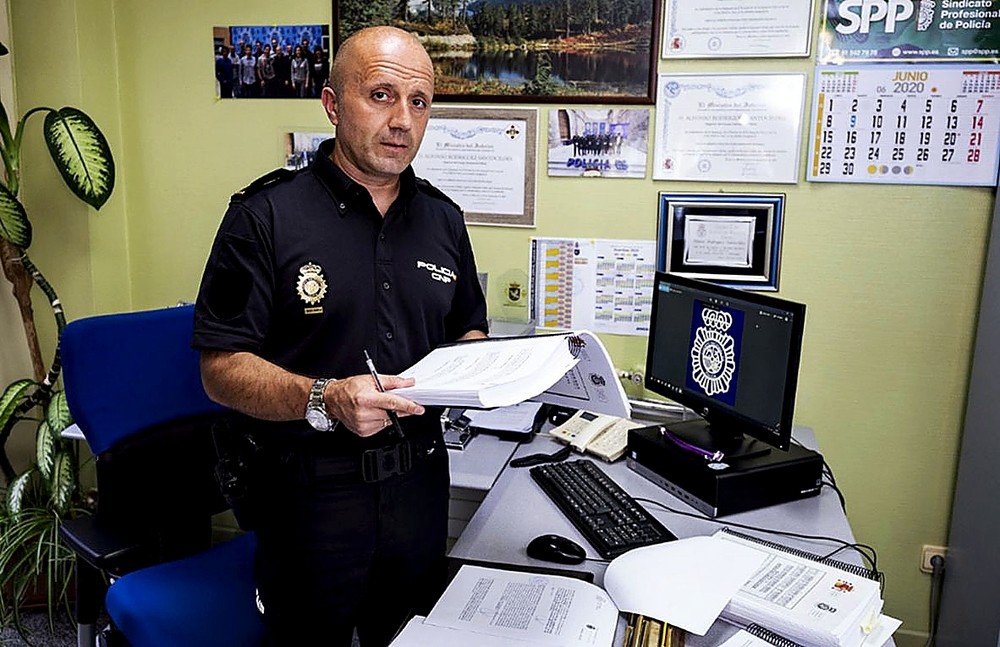
ALFONSO RODRIGUEZ: “I’VE NEVER MET ANYONE WHO’S LEFT THE FORCE, THIS IS LIKE A DRUG AND TO THIS DAY I STILL ENJOY WHAT I DO”
GINEBRA ROCHA
An example of service to society and common good, a peace of mind for citizens, a reference for the National Police; Alfonso Rodríguez, head of the group II of the Judicial Police

Wed 13 Jan 202113.00 GMT
Alfonso Rodríguez is not just any random policeman; he is the chief inspector of group II of the Judiciary Police : A specialized unit within the State Security Forces and Bodies aimed against crime. Right now, he is working in Burgos, but his past work against drug trafficking in Las Palmas marked him for life. Endless hours of training, effort, vocation, and sacrifice are the characteristics that define agent Rodríguez and that, according to him anyone that joins the police force should have.
“You could say I entered the police force out of vocation; I always knew the worked I choosed had to involve helping others and service society. I did not have any family that had worked in the police department before neither there was something in particular that sparked my attention at first, which usually is the most common reason to join the force. My childhood friends always say that when I was just a little kid I always said that when I grew up I was going to become a police inspector and I’ve achieved that.”
For entering the Spanish National Police, it does not matter whether you come from the streets, from the executive scale or if you have a university degree. There’s physical tests you have to undergo to be prepared for what you might face in the future.
“Since day one in the Formative School, located in Avila, we started training. Personal defense techniques, how to handle and use guns and so on. The most important thing is to never forget what our work requires and demands. The same training is required in all Spanish autonomous communities. After the training, police can choose what path they want to head to. Some of us have decided to follow the operational route, which is logically much more exposing than the management route. There are also special groups (such as SWAT ) who have need a very special training because they have to handle more critical situations such as an accident with hostages or boarding a ship on the high seas etc … ,”
“I started in Las Palmas in the Drugs and Organized Crime Unit where we dedicated ourselves to investigate the drug trafficking and crimes against public health on a medium and large scale,” he adds. “That is when you realize the real power of drugs, the money that moves and the level of sophistication of some narco-traffic organizations. You had to always keep in mind that the police answer had to be convincing because if not the situation could easily overcome us. It was hard but rewarding at the same time. That scenario has nothing to do with the function I do here today in Burgos, which consists in investigating crimes against other people. I’ve gone through a dozen of homicides, extorsion cases and its definitely really different from when I was working against drug trafficking. The complexity of a crime that involves drugs is different from what it is involved in a homicide. “
For entering the force at a basis scale the General Certificate of Education (GCE) is required. The vast majority that apply now a days have achieved a University Degree and that entails an enrichment for the organization and being able to achieve the best teams. Usually someone that comes new to the force has a lot of interest but little experience, the objective of the organization is making them gain experience and learn, without loosing their initial interest. That’s why the usual dynamic used in the force is to make pairs teaming with new unexperienced and older experienced policemen. They also need to be supervised more than usual just in case they do not make any mistakes.
“I would ask for anyone that joins,” he says. “To take their work seriously, and most importantly that they enjoy what they do; it is a job that you must enjoy, it enriches you in a personal and professional level. The experiences that they are going to go through as officers is an experience that no other job in the world offers. Some peers even say the would pay for living so many things.”
The COVID-19 crisis left a very big impact on police forces. Indeed, the police, along with firefighters and other rescue units, where the first line to respond, attending all the emergencies and new safety measures arising from the health crisis while at the same time continuing with the responsibility to maintain public safety.
“I believe that whether we’ve handled the situation correctly, should be something for citizens to decide,” he adds. “But we feel we’ve done our best. They trained us to fight and face many things but not a global pandemic. Since the beggining, operational plans and containment plans where developed that made our role succesful and that the rest of citizens have followed through. We were all filled with pride when we were driving past by the main avenue in Burgos and we received standing ovations from the people. I got goose bumps. We were not doing it badly, if people where receiving us like that, even though our main job was taking care that everyone stayed at their homes. According to a study by CIS, more than 58% of the population have a better image of the police after the pandemic.”